01 — About




02 — Research
Agents fail in boring ways. They call the wrong API, malform an argument, assert a fact they have no business being sure about — and then carry on as if nothing happened. I work on the data and rewards that make AI agents reliable enough to act on real systems, and on measuring how much of what they say can be trusted. Not by making the models bigger.
Agents that use tools
Agents fail at tool calls for unglamorous reasons: malformed arguments, the wrong API, no recovery. I generate verifiable tool-call trajectories from real APIs at scale, and train on failure rather than only on success.
Agents that simulate people
If an agent reproduces how a real shopper browses, hesitates and buys, a product can be evaluated without running a study on humans. I train LLM and VLM agents to simulate behaviour, with rewards grounded in observed sessions.
Measuring what models hide
Token-level confidence is noise and sequence-level confidence cannot point at the error. I estimate uncertainty over semantically coherent spans, and study what edits to a model leave behind in its outputs.
Unlearning & concept erasure
Making a generative model forget a concept is easy to claim and hard to verify. I build erasure methods that survive adversarial prompting, and the attacks and benchmarks that show when they do not.
Earlier work — zeroth-order optimisation and memory-efficient training (DeepZero, ZO-LLM benchmark, Black-Box Defense), dataset pruning and coreset selection (Selectivity Drives Productivity), and diffusion personalisation (ID-Patch · CVPR 2025).
03 — Service
- Area ChairNeurIPS
- Journal ReviewerTPAMI
- Conference ReviewerNeurIPSICLRICMLCVPRECCVICASSP
04 — Publications
2026
2025
2024
2023
2022
-
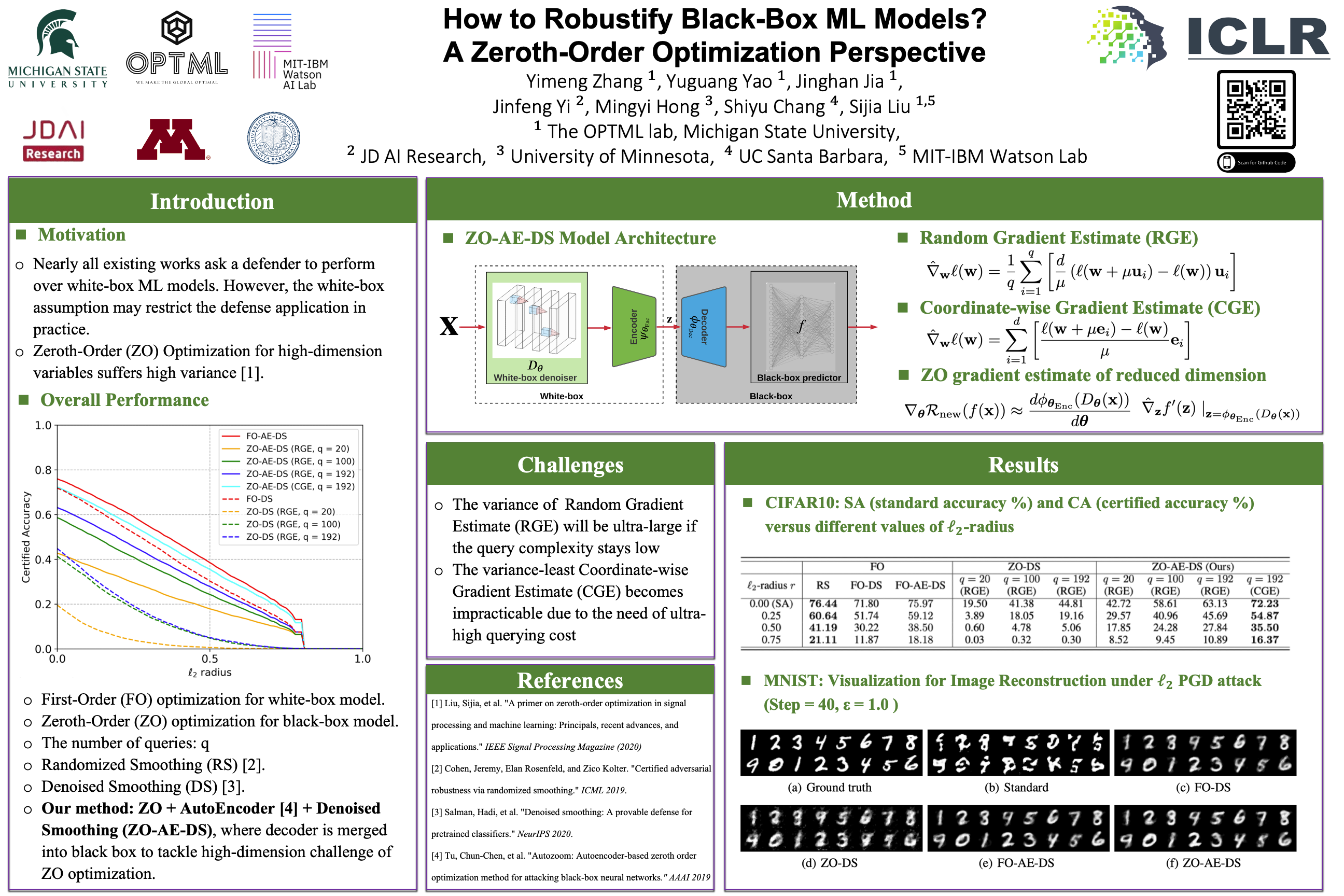
How to Robustify Black-Box ML Models? A Zeroth-Order Optimization PerspectiveICLR 2022Spotlight · top 5%